



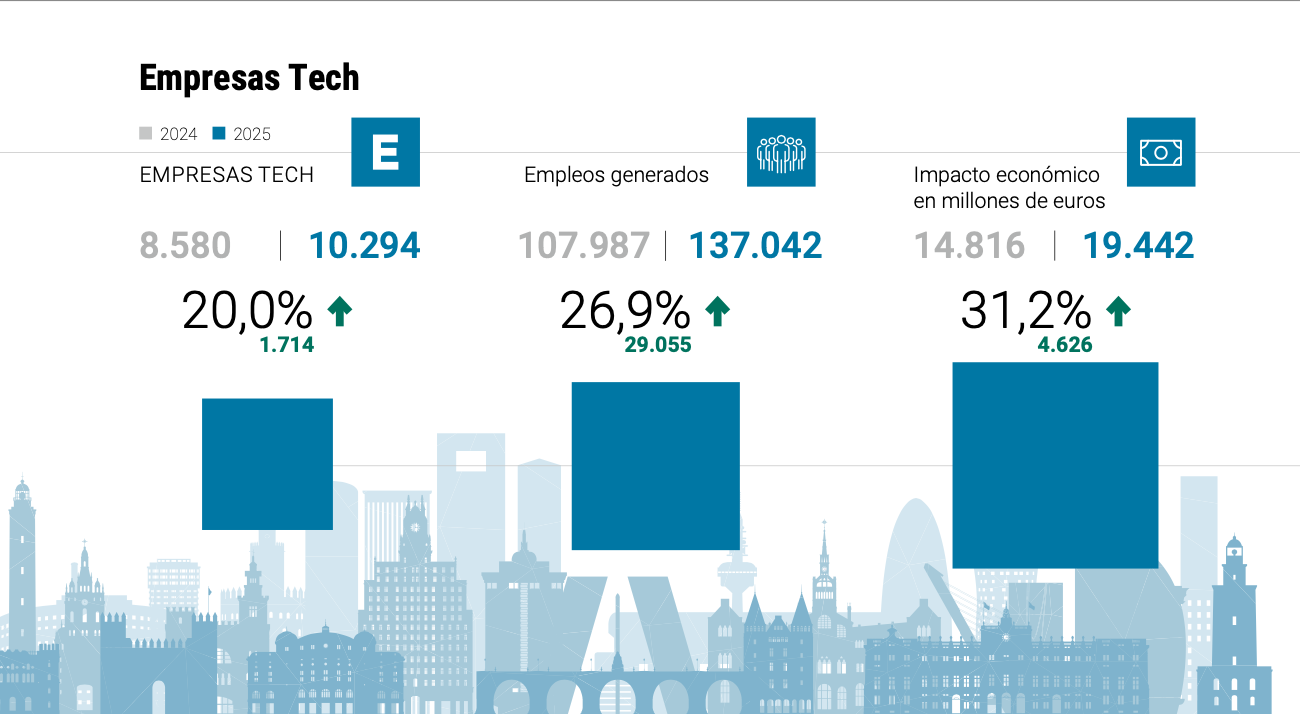
Spain’s technology ecosystem continues to accelerate its growth and is entering a new phase of consolidation and maturity. Spain closed 2025 with 10,294 active tech companies, compared to 8,580 the previous year, representing 20% growth and confirming the sustained expansion of the country’s innovation ecosystem.
According to the National Tech & Innovative Companies Report 2026, prepared by Scoutyn using validated data from the Spanish Mercantile Registry, Spanish tech companies now generate 137,042 jobs and €19.442 billion in economic impact, with increases of 26.9% and 31.2%, respectively, outpacing even the growth in the number of companies.
The report also reflects a structural shift within the ecosystem. While the number of startups slightly declined from 5,010 to 4,856 companies, the growth of scaleups and tech SMEs points to increasing business maturity. Scaleups have now reached 672 companies, while tech SMEs have grown to 4,605 companies, consolidating their role as the main economic driver of the Spanish tech ecosystem.
Madrid narrows the gap with Catalonia
Catalonia remains Spain’s leading region by number of tech companies, with 2,632 businesses, although Madrid has now reached 2,607, reducing the gap to just 25 companies. Both regions continue to concentrate a significant share of Spain’s technology ecosystem and invested capital.
In addition, the city of Madrid consolidates its position as Spain’s leading tech city, with 1,801 tech companies, 833 startups and 140 scaleups, leading all three major categories ahead of Barcelona.
Meanwhile, Andalusia posted one of the strongest advances of the year, becoming the fastest-growing top five region in percentage terms. The region grew from 714 to 885 tech companies and is also the only major Spanish region to increase its number of startups.
Artificial Intelligence drives the biggest leap in Spain’s tech ecosystem
One of the report’s most significant findings is the explosion of Artificial Intelligence within Spain’s technology ecosystem. AI has already become the third-largest vertical by number of tech companies in Spain and the fastest-growing sector during 2025.
Spain currently has 959 companies specialized in Artificial Intelligence, compared to just 309 the previous year, representing growth of more than 210% in only twelve months. This confirms the rapid adoption of AI-based technologies and the growing strategic importance of the sector within Spain’s innovation landscape.
The rise of AI is also driving the transformation of multiple technology verticals and economic sectors, from healthcare, fintech and advanced industry to energy, mobility, education and business automation. The report highlights that a significant share of new tech entrepreneurship in Spain is now being built directly around AI-based business models, marking a new phase of specialization and sophistication for the national ecosystem.
At the same time, SaaS ranks as the country’s leading tech vertical with 1,387 companies, followed by eHealth with 1,000 companies and Artificial Intelligence with 959.
Other major sectors include Foodtech (568), Energy (526), Biotech (523), Edtech (515) and Fintech (479).
The report also highlights sustained growth in sectors such as Big Data, sustainability, mobility, cybersecurity and automation, reflecting the increasing technological specialization of the Spanish ecosystem.
More than €3.21 billion invested in Spanish startups
Investment in startups and innovative companies exceeded €3.21 billion across 327 deals over the past year. Catalonia and Madrid remain the main hubs for attracting capital and together account for nearly 77% of all startup investment in Spain.
The report also notes that Spain has now accumulated more than €15.5 billion invested in startups over the last five years and remains one of the few European ecosystems capable of maintaining high investment levels despite ongoing global economic uncertainty.
Spain’s ecosystem also shows increasing business and financial consolidation, marked by the growth of scaleups, larger funding rounds and the emergence of companies capable of competing internationally and attracting global capital.
The gender gap remains unchanged
Despite the ecosystem’s overall growth, the gender gap remains one of the sector’s main unresolved challenges. Women account for only 17% of founders of technology companies in Spain, a figure that has remain ed virtually unchanged compared to the previous year.
Among solo-founded startups, female representation stands at 18%, reflecting the persistence of structural barriers within tech entrepreneurship.
The report concludes that Spain is entering a new phase of technological consolidation, where the challenge is no longer only to create startups, but to scale companies capable of competing internationally, attracting major investment rounds and generating sustained economic impact.
The report has been supported by some of the leading public and strategic organizations within Spain’s innovation and entrepreneurship ecosystem. Key partners include CDTI Innovación, ENISA and ICEX, all of which play a major role in fostering innovation, international expansion and funding for Spanish technology companies.
Regional partners also include Fundación madri+d, the Basque Government, Xunta de Galicia, the Government of La Rioja, SODERCAN, the Region of Murcia, CEIN, Instituto Aragonés de Fomento (IAF) and IMPULSE Tech Transfer Fund, alongside innovation ecosystem corporations such as SANTALUCIA Impulsa.
Strategic partners supporting this year’s report include Samaipata, Kibo Ventures, Madrid City Council, Endeavor and Las Rozas Innova.