



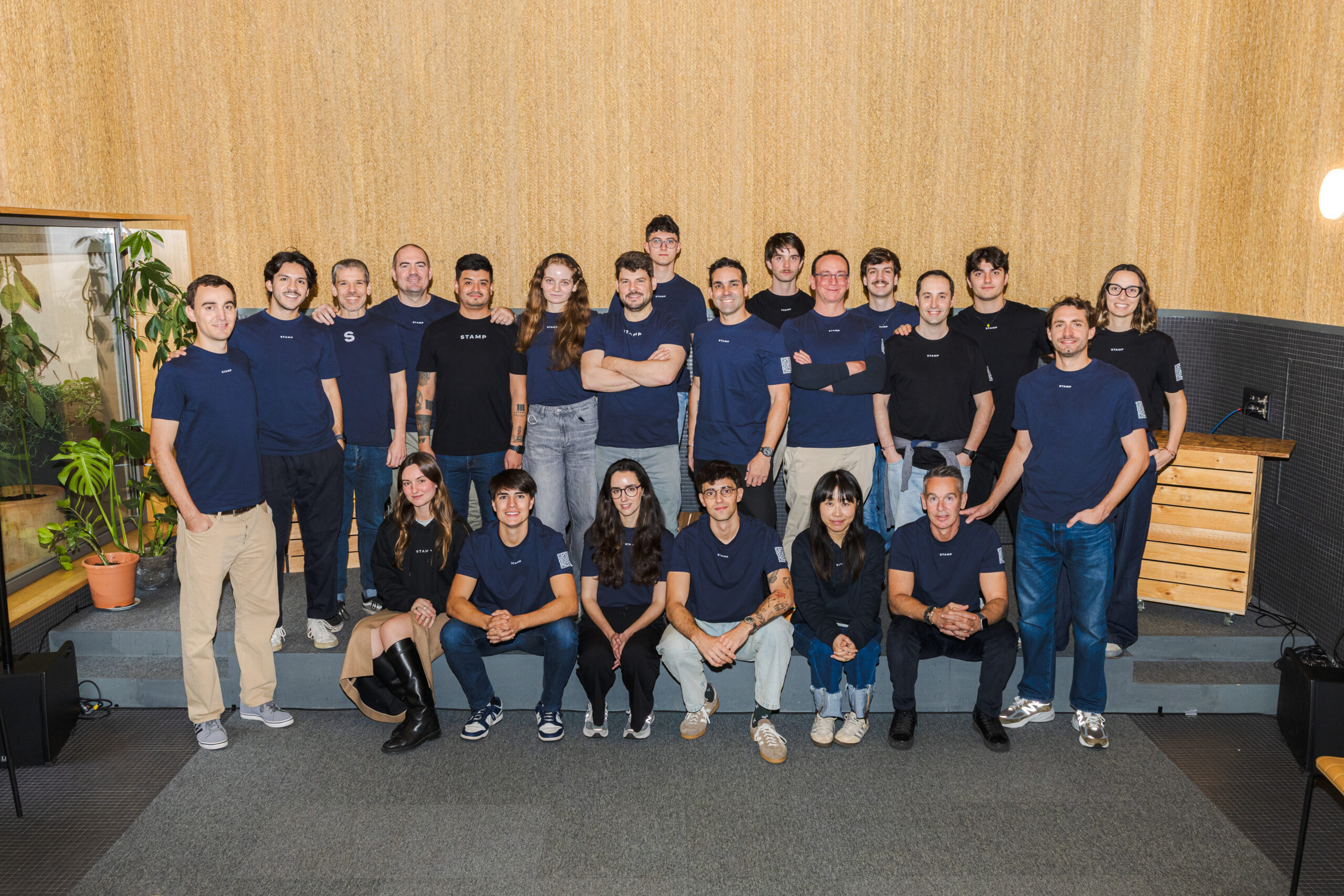
Spanish fintech STAMP has raised €4 million in funding to modernise the global Tax Free industry and strengthen the development of new technology products, including services based on artificial intelligence.
STAMP will advance its mission through a round led by Dozen, with participation from EBISU Digital, FC Barcelona’s investment vehicle Barça Innovation Hub, and several high-profile international business angels, including Andreas Mihalovits and Thibaut Courtois, who invested through his investment arm NXTplay.
With this transaction, STAMP strengthens its position as one of the most relevant emerging technology platforms operating in the fields of global commerce, international payments and the activation of Tax Free entitlements in Europe.
Growth in key markets and a focus on product and AI
The capital raised will be used primarily to accelerate STAMP’s expansion in its current markets — Spain, Italy and Portugal —, as well as to further develop its product offering, with a particular focus on advanced international payment solutions and the launch of a new AI-based product.
The company operates amid a transformation of shopping tourism and European retail, driven by the growth of international customers and the need to eliminate friction at the most critical moment of the sale: checkout.
“This round allows us to execute our roadmap with greater determination and solidity. Our objective is clear: to fulfil our mission by empowering merchants in Southern Europe to serve global customers, removing friction from the payment process and activating Tax Free as a real purchase incentive for consumers,” said Abel Navajas, CEO of STAMP.
To achieve this, the company has opted for a different investor profile from traditional venture capital. “We have chosen partners who not only provide capital, but who are actively involved in our mission and help accelerate adoption in the market. These include EBISU, an investment boutique focused on fintechs such as MyInvestor, Flanks and Flinket, and Dozen, a participatory investment platform from the Orbyn Group, with a track record of investments in companies such as Glovo and scaleups like Cuideo,” Navajas explained.
He also highlighted a specific growth opportunity in football merchandising. “We have identified a major business opportunity in the football merchandising vertical. Spain and Italy are home to some of the world’s most relevant clubs, attracting millions of fans. When these fans visit, they want to take home merchandise from their team with VAT savings and using their preferred payment methods. Neither Barça nor Courtois need an introduction — both perfectly represent today’s global football economy,” he added.
A model that turns Tax Free into a sales driver
Unlike the traditional VAT refund (Tax Refund) system — based on complex post-purchase reimbursement processes, intermediaries and opaque commissions — STAMP has developed a technological model that activates the tax benefit directly at the point of sale, integrating it into the payment experience in a digital manner and in compliance with European regulation.
STAMP’s model adapts to the fiscal framework of each country in which it operates. In markets where regulation allows, such as Italy, purchases can be made VAT-exempt directly at checkout. In other countries, such as Spain, invoices are always issued with VAT, but customers receive an immediate discount equivalent to the VAT amount at the moment of payment, activating their Tax Free entitlement. The platform subsequently validates the transaction, ensures full traceability and manages recovery — even in fraud scenarios — so that merchants can reimburse the relevant tax authority without assuming fiscal risk.
This approach allows merchants to use Tax Free as a true commercial lever, increasing conversion rates, average basket size and satisfaction among international customers, particularly in a context of rising Asian tourism and consumers accustomed to native digital payment methods.
“For more than 40 years, so-called Tax Free has failed to deliver on its promise, functioning in practice as a Tax Refund,” Navajas concluded. “Global consumers have often felt confused or even misled when a service advertised in-store did not materialise as expected — it is like claiming to accept credit cards and ultimately only allowing cash payments. Tax Free, as applied until now, has operated more as an administrative procedure than as an automatic consumer right. When that friction is removed, customer behaviour changes and merchants regain control over both the shopping experience and their margins. STAMP delivers, for the first time, a real Tax Free model that does not require regulatory change, provides maximum security and prevents fraud.”
Institutional backing and public funding
In addition to private capital, STAMP has secured public grants from the Spanish Ministry of Industry and Tourism, the City of Valencia, the Community of Madrid and the City of Madrid. This institutional backing reinforces the project’s viability and its alignment with policies focused on digitalisation, tourism and the modernisation of commerce.
Spain as a hub for global commerce innovation
The participation of technology, consumer and sports-focused investors such as Barça Innovation Hub highlights STAMP’s potential to scale its model beyond luxury tourism and extend it across the broader European retail ecosystem.
As local merchants increasingly compete to attract global customers, STAMP aims to become a key infrastructure layer, enabling European retailers to sell without friction, with payment methods adapted to international consumers and an intelligent activation of fiscal incentives.